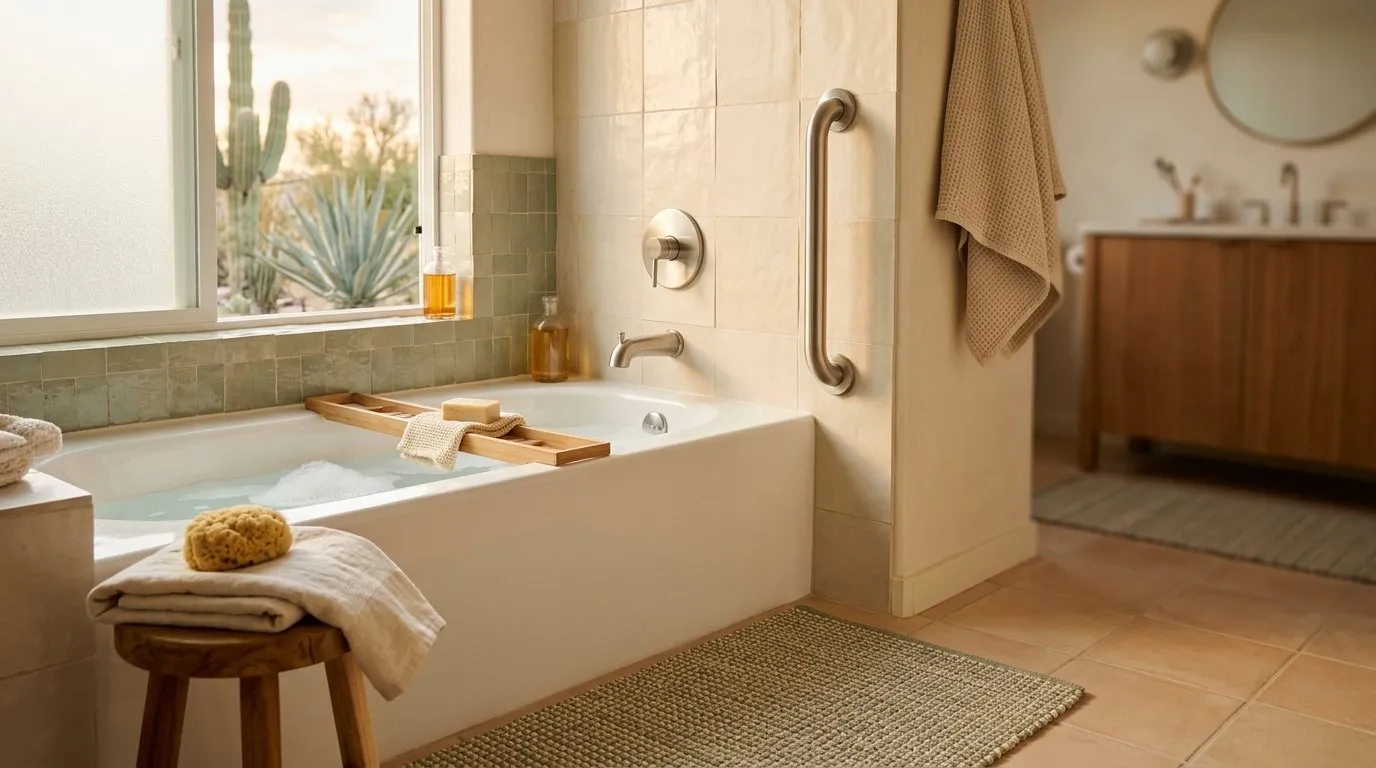
For most people over 60, the right bathroom night light is a motion-activated plug-in with a warm amber LED — something that turns on by itself when you step into the hallway and shuts off a minute after you leave. The GE Ultrabrite Motion-Activated LED is the sensible default: it plugs straight into any outlet, throws enough light to see the floor and the toilet clearly, and uses a warm tone that won’t jolt your eyes awake at 2 a.m.
If your bathroom outlet is already full, or the route from bed involves a long hallway, you’ll want to pair it with a battery-powered stick-on light near the bed and possibly a toilet bowl light. More on both below.
The reason this matters isn’t dramatic — it’s just that a dark, unfamiliar few feet of floor at night is where most trips and stubbed toes happen. A light that comes on by itself removes the one step (finding the switch) that tends to go wrong when you’re half-asleep.
What actually matters in a bathroom night light
Four things, in roughly this order:
Warm color temperature. Look for 2700K or lower — often marketed as “warm white” or “amber.” Cool white and blue-toned LEDs are what you’ll find in most cheap night lights, and they’re the worst choice for middle-of-the-night use. Warm amber is easier on the eyes when you’re adjusting from darkness and less likely to make it hard to fall back asleep. If a listing doesn’t specify the color temperature, assume it’s cool white and skip it.
Motion sensor with auto-off. The whole point is hands-free. A good sensor picks you up from six to ten feet away, stays on for 30–60 seconds after you stop moving, then shuts off. Some let you adjust the timer, which is useful if your bathroom routine runs longer than one minute.
Appropriate brightness. Counterintuitively, brighter is not better. You want just enough light to see the floor, the toilet, and the sink clearly — somewhere around 15–40 lumens for a bathroom. Anything brighter and you’re essentially turning on an overhead light, which defeats the purpose of preserving your night vision.
Placement that fits your layout. A plug-in works if you have an outlet near the floor in the bathroom or hall. A battery-powered stick-on light works where outlets don’t. A toilet bowl light is a nice add-on if you want aim-assistance without flipping on the vanity.
If your bathroom setup also includes stability concerns, it’s worth reading our guide to the best grab bars for bathroom safety over 60 — lighting and grab bars solve related but different problems, and most people need both.
Placement: where to put them
The three high-value spots:
- Bathroom itself — one plug-in near the floor, ideally on the wall opposite the toilet so it lights your path in.
- Hallway or bedroom-to-bathroom route — a second plug-in or a battery-powered stick-on, especially if there’s a doorway or corner where you can’t see from one light to the next.
- Bedside — a small motion-sensor light under the bed frame or on the nightstand, so you can see your slippers and the floor before you stand up.
The goal is continuous illumination from the moment your feet hit the floor to the moment you’re back in bed. No dark gaps.
The picks
GE Ultrabrite Motion-Activated LED Night Light (plug-in)
The default recommendation for the bathroom itself. Plugs into any standard outlet, has a built-in motion sensor and ambient light sensor (so it only triggers when the room is actually dark), and the amber-tinted LED is warm enough to use at 3 a.m. without feeling harsh. Light sweep covers a typical bathroom, and the auto-off is about 60 seconds.
Best for: anyone with an available outlet in the bathroom or adjacent hallway. Skip if: your only outlets are above counter height — the light will shine too high to be useful for floor-level navigation.
Mr. Beams Wireless Motion-Sensor LED Light (battery-powered, stick-on)
The pick when you don’t have a conveniently placed outlet. Battery-powered, mounts with adhesive or a couple of screws, and runs for roughly a year on a set of AA batteries with normal nighttime use. The light is slightly cooler in tone than the GE — not amber, but not harsh blue either. Good for under-bed placement, inside a closet, or on a hallway wall between bedroom and bathroom.
Best for: supplementing a plug-in, or when outlets aren’t available. Skip if: you want the warmest possible light — this one is more neutral white.
Toilet Bowl Night Light with Motion Sensor (generic category)
A small LED that clips to the rim of the toilet and glows a soft color when it senses motion. This is a comfort feature more than a safety one, but it does let you aim without turning on the vanity light. Most run on AAA batteries and let you pick a fixed color (amber or red are easiest on sleep) or cycle through colors. Several brands make essentially the same product; pick one with solid reviews and the ability to lock to a single warm color.
Best for: anyone who wants to avoid the vanity light entirely. Skip if: you have small grandchildren who’ll treat it as a toy, or a cat who will bat it into the bowl.
Rechargeable Motion-Sensor Pathway Light (generic category)
For a longer bedroom-to-bathroom route — down a hallway, around a corner — a USB-rechargeable magnetic strip light mounted along the baseboard or under a handrail covers the dark stretches. Charges every few weeks depending on use, and the warm-white versions are gentle enough for middle-of-the-night. Look for one with a dedicated warm-white (not RGB) setting.
Best for: longer or more complex routes to the bathroom. Skip if: your bathroom is attached to your bedroom and a single plug-in covers it.
FAQ
Why warm amber light instead of regular white? Warm light in the 2200K–2700K range is less disruptive to the body’s natural wind-down signals and easier on dark-adapted eyes. Cool and blue-toned light can make it harder to fall back asleep after a bathroom trip. The difference is small but noticeable, especially if you tend to lie awake afterward.
How bright should a bathroom night light be? Less bright than you’d think. Roughly 15–40 lumens is enough to see the floor and fixtures clearly without flooding the room. If you can read a book by it comfortably, it’s too bright for middle-of-the-night use.
Do motion sensors work through pajamas and blankets? Yes — motion sensors detect infrared heat and movement, not visible light, so clothing and bedding don’t block them. The sensor’s range (usually 6–15 feet) and detection angle matter more than what you’re wearing.
Will leaving a night light plugged in all night drive up the electric bill? No. A modern LED night light uses roughly 1 watt or less. Running one all night, every night, for a year costs about the same as a cup of coffee.
Can I use smart bulbs or app-controlled lights instead? You can, but for middle-of-the-night use, the simplest option is almost always the best. A dedicated motion-sensor night light has no app to open, no phone to find, and no setup that can break. If you’re already deep into a smart-home setup, motion-triggered smart bulbs on a schedule work fine — just make sure they default to a warm color at night.
Bottom line
Start with one warm-amber motion-activated plug-in in the bathroom itself. If the route from your bed involves a hallway, a corner, or a dark stretch where the bathroom light doesn’t reach, add a battery-powered stick-on light to bridge the gap. Keep brightness low, color warm, and sensor placement at floor level — that combination handles 90% of the problem for most households. If balance is also a concern on the way back to bed, pair the lighting plan with grab bars in the right spots and a non-slip option in the shower for a full nighttime bathroom setup.